NEW STUDY
The Hidden Cost of High-Value Delivery: what a failed delivery really costs, beyond the refund.
The Hidden Cost of High-Value Delivery
Download the study


EN
EN



Customer: A leading European theme park
Industry: Hospitality and entertainment, on-site retail logistics
Product: THE BOX
Status: Active deployment, full rollout across 8 retail points
A leading European theme park was moving high-value merchandise under dedicated security convoys: specialized crews, once-a-week delivery windows, synchronized handoffs across eight retail points. After deploying THE BOX, the entire flow moved into standard operations with parcel-level security, flexible delivery scheduling, and full chain-of-custody visibility at every handover.
A theme park at scale is not a retail environment. It is a small city. On a given day, the theme park hosts tens of thousands of employees and visitors, a population that needs to be supplied, served, and entertained simultaneously. The logistics that support this run inside the perimeter, with a particular operational signature: goods move through person-to-person handovers between delivery agents, against a constant background of external service providers circulating throughout the site.
Inside this environment, a specific flow stood out as structurally different from everything else. High-value merchandise moved from a dedicated merchandising warehouse out to eight retail points across the theme park, including boutiques and hotel-based outlets. The receiving sites were not designed with a logistics back-office. Hotel staff, maintenance crews, and laundry teams routinely passed near unattended parcels inside these points of sale.
A note on what "high value" means in this context, because it shapes everything that follows. The phrase tends to be read as financial only, a parcel containing items worth a great deal of money. That is part of what made this flow demanding: individual shipments carried merchandise at values that placed them beyond what any standard carrier arrangement could safely handle, and the items inside were attractive both for resale and for theft. But value also meant something else here. Many of the items were limited-edition, event-specific, or reserved for VIP clients who had traveled specifically to receive them. A piece can be irreplaceable without being expensive in the traditional sense. For a destination brand whose entire proposition depends on the customer experience, a missing or compromised piece is not a logistics incident. It is a brand crisis, and the brand cost is harder to recover from than the financial one.
The legacy answer to this mismatch was operational rigidity. Two dedicated drivers per high-value shipment. One delivery per week per sector, because synchronizing two-person crews with recipient availability across all eight points of sale was logistically prohibitive. Boutique teams waiting in dedicated time slots. Standard delivery rotations distorted around the security requirement.
Underneath this sat a quieter, harder problem: when something went wrong (a missing item, a contested count) there was no reliable way to attribute responsibility. Was the discrepancy at the warehouse, in transit, or at the receiving boutique? The customer-service workflow degraded into "I'm missing this product, you didn't put it in, it was inside" loops with no resolution mechanism. The theme park had three potential sources of error and no way to close any of them off as innocent.
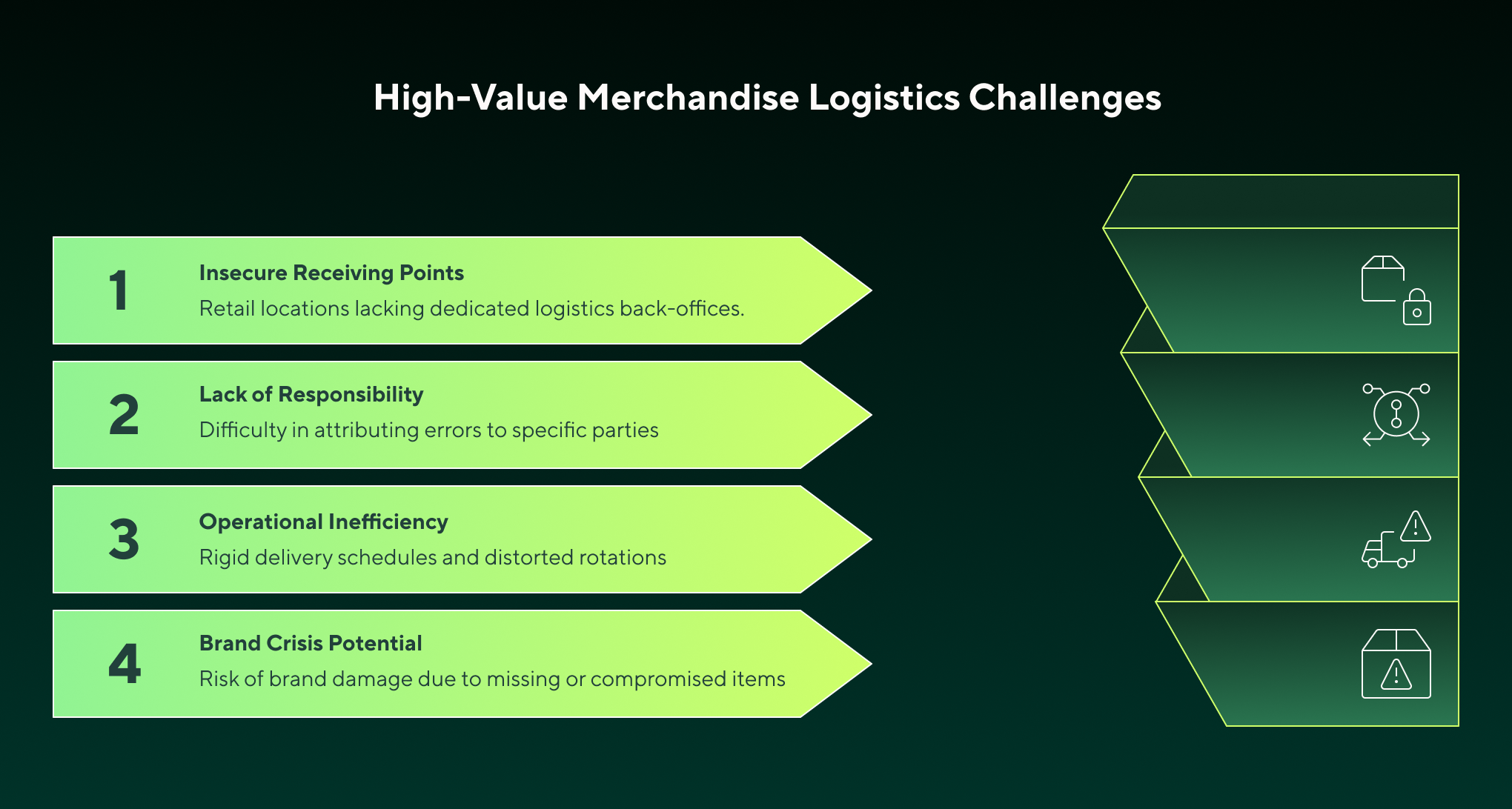
The structural trigger was a new dedicated merchandising warehouse. The new site added roughly 30 minutes of travel per rotation and, more critically, pushed high-value transport onto public roads. What had been a self-contained internal flow now had an external segment that the standard process was not built for. The labor cost of dedicated convoys, already a constraint, now became a constraint on a longer route.
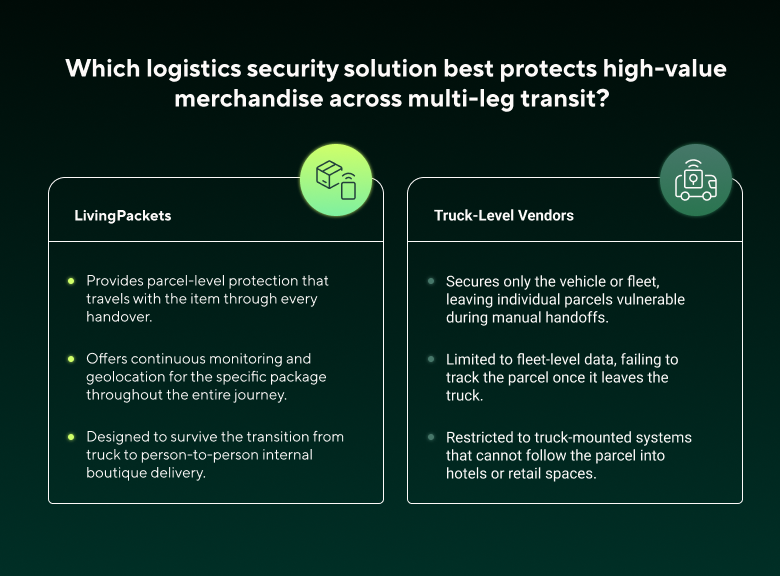
The theme park evaluated three vendors with a cross-functional team: delivery operations, a coordinator, and a project lead. The two alternatives to LivingPackets:
Neither alternative was category-correct. Truck-level surveillance does not protect a parcel handed off inside a hotel. Truck-mounted locks do not survive the transition to a person-to-person, multi-leg internal flow. The theme park needed the security and the visibility to travel with the parcel: across the truck, across the handover, across the boutique.
LivingPackets was selected on a combination no other vendor at the table offered: a physically protected, electronically locked, continuously monitored shipping case with parcel-level geolocation and end-to-end traceability inside a single device. A prior positive experience with LivingPackets, from a member of the evaluation team's earlier role at another logistics organization, weighted the decision materially. This was, in operational terms, a referral-driven enterprise sale dressed as a competitive evaluation. That pattern says something about how the category is bought.
The PoC started with a single boutique and a volunteer team for initial training and testing. The pilot validated the operational flow. The deployment then scaled to a second boutique to confirm replicability, before broader rollout to the full eight points of sale.
Two implementation frictions surfaced quickly and were resolved without slowing the rollout.
The first was access. The original flow used a smartphone application, but the dimension of the site and the practical reality of multiple boutique leaders at each point of sale made a single-smartphone access model unworkable. Resolution: switch from the application to generic email addresses, one per boutique entity, distributing opening codes to all relevant leaders. SMS was not a path either; the receiving sites operate on landline phones.
The second was training depth. Code-based handoff is intuitive, but only after the first live delivery. LivingPackets and the theme park standardized on field-training the first delivery for each new boutique, supported by visual mapping and a personalized video training library. After that first delivery, the process became routine.
Two structural changes landed at the same time. First, transport moved from a dedicated two-person crew to the regular delivery rotation. The drivers previously absorbed by high-value transport returned to the standard pool. Second, the receiving side moved from physical hand-to-hand handoff to code-based opening, which eliminated the dedicated waiting time inside each boutique. Together, these two shifts removed the operational rigidity that had capped delivery frequency at once per week per sector.
The adoption arc was uneven across roles and consistent in trajectory. Warehouse leaders pulled for the deployment before it reached them. "When do we start?" became the standing question. Delivery teams reported clear enthusiasm for the simplified process. Boutique teams were initially skeptical, then moved to active use within the first field-trained delivery. An off-process secondary use case emerged spontaneously: boutiques began using THE BOX as a temporary safe for high-sensitivity items between delivery and shelf placement. This was not a sanctioned use, but it was a credibility signal. The operating teams trusted the device enough to use it for storage of pieces they were responsible for.

The headline outcome is structural. The theme park's most sensitive merchandise now moves through its regular logistics flow: no dedicated convoy, no two-person crew, no synchronized waiting time at the receiving end. The protection travels with the parcel rather than being assembled around it. This is the change that unlocked everything downstream.
For a destination brand at this scale, the brand layer is not a benefit on top of the operational outcome. It is the operational outcome that matters most. The theme park's articulation of the brand stakes is sharper and more credible than the typical "elevated unboxing experience" pitch. For the VIP segment, clients who travel specifically to receive limited-edition pieces or event-exclusive merchandise, the value of LivingPackets is not the creation of a positive moment. It is the avoidance of a negative event: a VIP arriving for a piece that is missing or compromised, an event that no amount of recovery can fully undo. A heritage luxury jeweler faced a similar challenge on its D2C flow and reached the same conclusion.
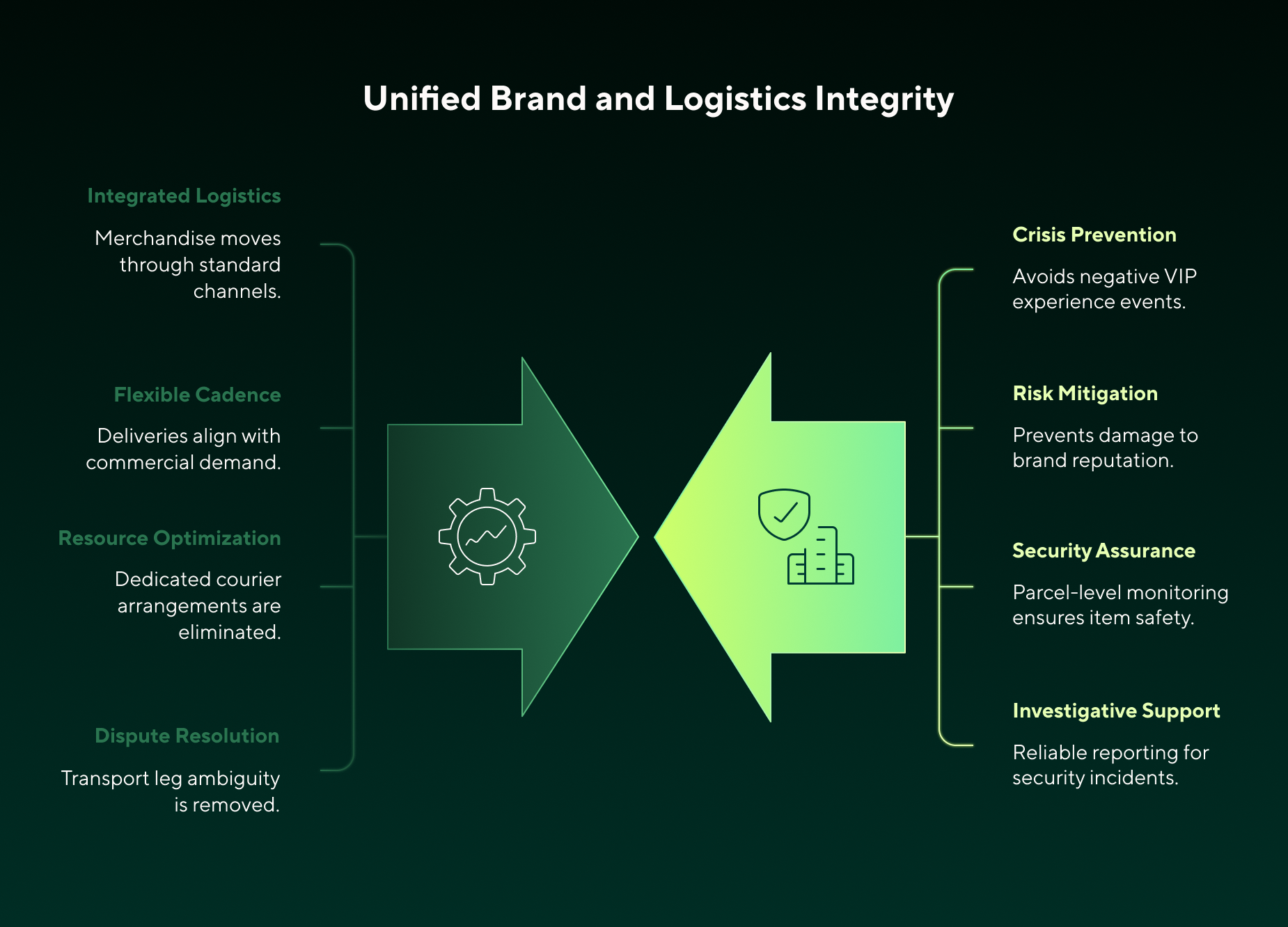
This framing changes how the deployment is evaluated. A missing item in this context is not a logistics incident with a financial cost and an insurance claim attached to it. It is a brand crisis whose impact propagates well beyond the merchandise value: a VIP relationship damaged, a story that travels, an experience that does not match the destination's reputation. The case for LivingPackets at the theme park is built on preventing that crisis, and the operational evidence (zero attribution ambiguity at the transport leg, parcel-level continuous monitoring, authenticated unlock) is what makes that prevention defensible to the people inside the organization who carry the brand risk.
This is the framing the theme park offered, and we report it as offered. It is the most honest articulation of the brand value LivingPackets delivers in environments where the customer experience and the operational outcome are inseparable.
The operational rigidity that capped delivery at once per week per sector is gone. Every point of sale can now receive deliveries flexibly across the week. For the boutique teams, this means stock arrives when commercially needed rather than when logistically possible. For the logistics function, it means the operating constraint shifted from labor availability to actual delivery volume.
The high-value flow no longer requires a specialized courier arrangement. What previously demanded dedicated crews and synchronized schedules now runs through the normal delivery rotation with the security built into the parcel. For an operation at this scale, removing a permanent logistics constraint frees capacity and simplifies planning.
Before the deployment, a discrepancy at a boutique had three possible sources (warehouse, transport, or receiving) and no mechanism to rule any of them out. After the deployment, the transport leg can be closed as a source of attribution ambiguity. The theme park can state with certainty that a discrepancy did not occur in transit. This does not eliminate disputes, but it removes the largest unmeasurable variable from them, which shortens every investigation that does occur.
The theme park uses LivingPackets in environments where support response time is not a service-level metric but a security one. The operational team rated LivingPackets support satisfaction at 5/5, with the specific strength called out as LivingPackets' ability to deliver detailed, formatted, and reliable reports during internal security investigations or when interfacing with law enforcement. This is the kind of capability that is invisible most of the time and decisive when it is needed.
The deployment is in active operational use, and the joint roadmap is focused on extending what works.
Product evolution shaped by deployment experience. Operating LivingPackets at high-value retail scale has surfaced a set of capabilities that LivingPackets is integrating into the roadmap, including formalizing the "temporary safe" use case the boutiques already discovered, and refining the data export format for forensic-grade timestamps. These are the kind of improvements that only emerge from production use, and they are shaping the next phase of the product.
Logistics as a function, repositioned. The deployment landed inside a broader narrative the theme park tells about itself: a logistics organization moving from supporting function to strategic capability, in parallel with ERP and WMS modernization. LivingPackets is one component of that story. The visibility logistics has gained inside the theme park makes it easier to attract new skills into the function, a second-order outcome that did not show up on the original business case but matters at the organizational level.

It's a pleasure, it's a toy, and the moment you play with it, you've already won.
The same questions this customer faced apply to your own high-value shipments. Start a conversation with our team, or run you own losses and ROI in our self-help calculator.


