NEW STUDY
The Hidden Cost of High-Value Delivery: what a failed delivery really costs, beyond the refund.
The Hidden Cost of High-Value Delivery
Download the study


EN
EN



Customer: A major French telecom retailer
Industry: Telecom retail, distributed network, sensitive device logistics
Product: THE BOX
Status: National deployment, scaling from 1,300 to 1,600 boxes by end of 2026
Region: Mainland France and Corsica
A major French telecom retailer shipping hundreds of sensitive devices per day across 130+ stores was dealing with recurring spoliations and breaks in traceability across its carrier network. Standard tools documented incidents after the fact but couldn't prevent them. After deploying THE BOX at national scale (1,300 units and growing), the retailer achieved a 93% reduction in loss and damage claims, with 100% of theft and traceability incidents now prevented or resolved.
A distributed retail network does not move goods from one place to another. It moves them across hundreds of handovers: from a central logistics provider to a carrier, from the carrier to a store, from a store back to a reconditioning partner. Every handover is a moment where chain of custody can break. For most categories of goods, this is an acceptable risk. For consumer electronics (smartphones, accessories, replacement units, sensitive equipment with high resale value) it is the operational problem that quietly defines the entire logistics function.
A major French telecom retailer was running this flow at scale. Hundreds of sensitive device shipments moved every day from a central logistics partner out to a retail network spanning mainland France and Corsica. The standard tools available to manage this (tamper seals, carrier scans, insurance) did what they were designed to do, which is largely to document what happened after something went wrong. Two specific problems kept surfacing: spoliations on sensitive flows, and breaks in traceability across handovers. Neither could be fully eliminated inside a generic shipping model.
The operational cost was not just the loss of devices. It was also the chain of investigation that followed every incident: the time spent by logistics teams chasing back through scan data that did not exist, the carrier conversations that ended in dispute rather than resolution, and the store managers explaining device unavailability to customers. The retailer did not have a packaging problem. It had a control problem, and the packaging was where the control was missing.
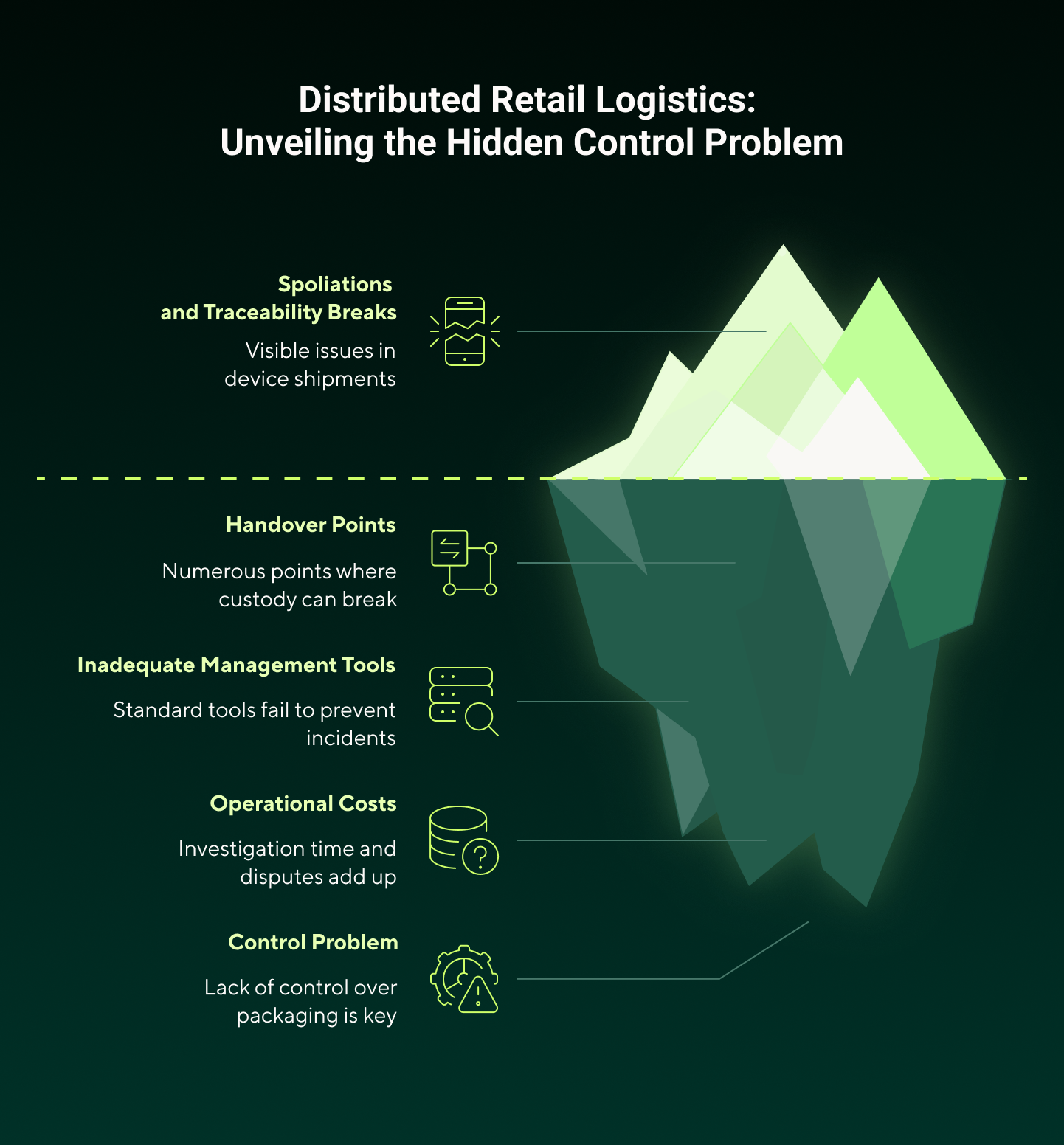
The decision to deploy LivingPackets came from a clear operational thesis: if chain of custody is the problem, the answer has to live inside the parcel itself. Not in the contracts wrapped around it.
The retailer evaluated the alternatives that the market offered:
LivingPackets offered a different proposition: turn the parcel itself into the security and visibility layer. A physically protected, electronically locked, continuously monitored shipping case that could move through the retailer's existing carrier network at retail scale, while generating the data needed to close the chain of custody at every handover. The model was not about adding hardware to a flow. It was about replacing the assumption (that the box is dumb and someone else is responsible for what happens to it) with a structure where the box is the operational asset and the data is the evidence.
The deployment followed a deliberate ramp. After an initial PoC starting in June 2023, the retailer launched its first national deployment in March 2024 with 220 THE BOX units in circulation. By June 2025, the fleet had grown to 1,000 boxes. By December 2025, less than two years after the national launch, it reached 1,300, with a plan to hit 1,600 by the end of 2026. The scaling curve matters: it is the proof that what worked at pilot worked at production volume. Enterprise deployments often die in the gap between the two. This one did not.
The single most important operational innovation in this deployment lives at the dispatch point. LivingPackets installed an automated dispatch workstation at the retailer's logistics provider. The workstation generates hundreds of digital labels per day, without paper, without glue, without single-use plastic, and deploys each THE BOX into the carrier network without manual intervention. This is what made the model industrializable at scale.
At the receiving end, store teams get shipment information in advance. They verify the carrier on arrival, then unlock THE BOX via Bluetooth using a mobile app. The unlock requires either the intended recipient's presence or a secure code. The workflow change at store level is intentionally small: the team's daily routine is faster and more predictable, not more complex. A connected packaging system that demands new workflows at every touchpoint tends to break at the slowest one. This one was designed to disappear into the existing motion.
Reverse logistics is where most reusable systems fail in practice. The retailer's model handles this by preloading return labels into THE BOX automatically. Store teams can ship devices to reconditioning partners in two clicks, without cardboard, without a manual labeling step. The reuse data tells the story of how well this works at scale: some THE BOX units have completed more than 120 shipments since the PoC launch in June 2023, with the fleet averaging up to four shipments per unit per month. This is not theoretical reusability. It is reusability that survives daily contact with a warehouse, a carrier network, and a hundred store teams.
The retailer's team adoption arc is consistent with what LivingPackets sees across enterprise deployments: a short familiarization period at pilot, followed by rapid embrace once the operational benefit becomes obvious. The retailer's logistics and store teams reported that operational stress dropped noticeably as exception management decreased. For a function that runs on managing what goes wrong, the absence of constant firefighting is the strongest possible signal that the model is working.
Within LivingPackets-managed flows, the retailer reports that thefts and breaks in traceability are now either prevented outright (by the electromechanical lock and authenticated unlock) or resolved by the shipment data captured continuously across the route. 100% of these incidents are now prevented or resolved within these sensitive flows. The "or resolved" qualifier matters. The point is not that no abnormal event ever occurs in transit; the point is that when one does, the operational team retains control, with evidence and accountability.
The retailer has validated a 93% reduction in loss and damage claims on the flows running through THE BOX. Each claim that no longer needs to be filed represents not just an inventory recovery but the removal of the entire downstream chain that followed: the investigation, the carrier dispute, the store-level explanation, the documentation work. The 93% figure is the operational headline. The absence of the work that used to surround each loss is the daily experience. Another LivingPackets customer validated 11:1 ROI on a different flow type, with similarly dramatic before-and-after numbers.
The deployment gave the logistics team a capability it did not have before: the ability to redirect sensitive flows based on spoliation data. When incident rates spike on a particular route, the logistics manager can reassign THE BOX to different destinations through the WMS integration. THE BOX is destination-agnostic; the change happens in the system, and store teams at the new destination learn the unlock workflow within a single delivery. The retailer has adjusted destinations multiple times since the start of the contract without disruption, a kind of operational agility that rigid security arrangements cannot offer.
Boxes in the field have demonstrated durability at scale. With some units completing more than 120 shipments since the PoC launch and the broader fleet averaging up to four shipments per unit per month, the per-shipment unit economics improve continuously. This is what makes the subscription model work, and it is what positions THE BOX as an operational asset rather than a recurring cost.
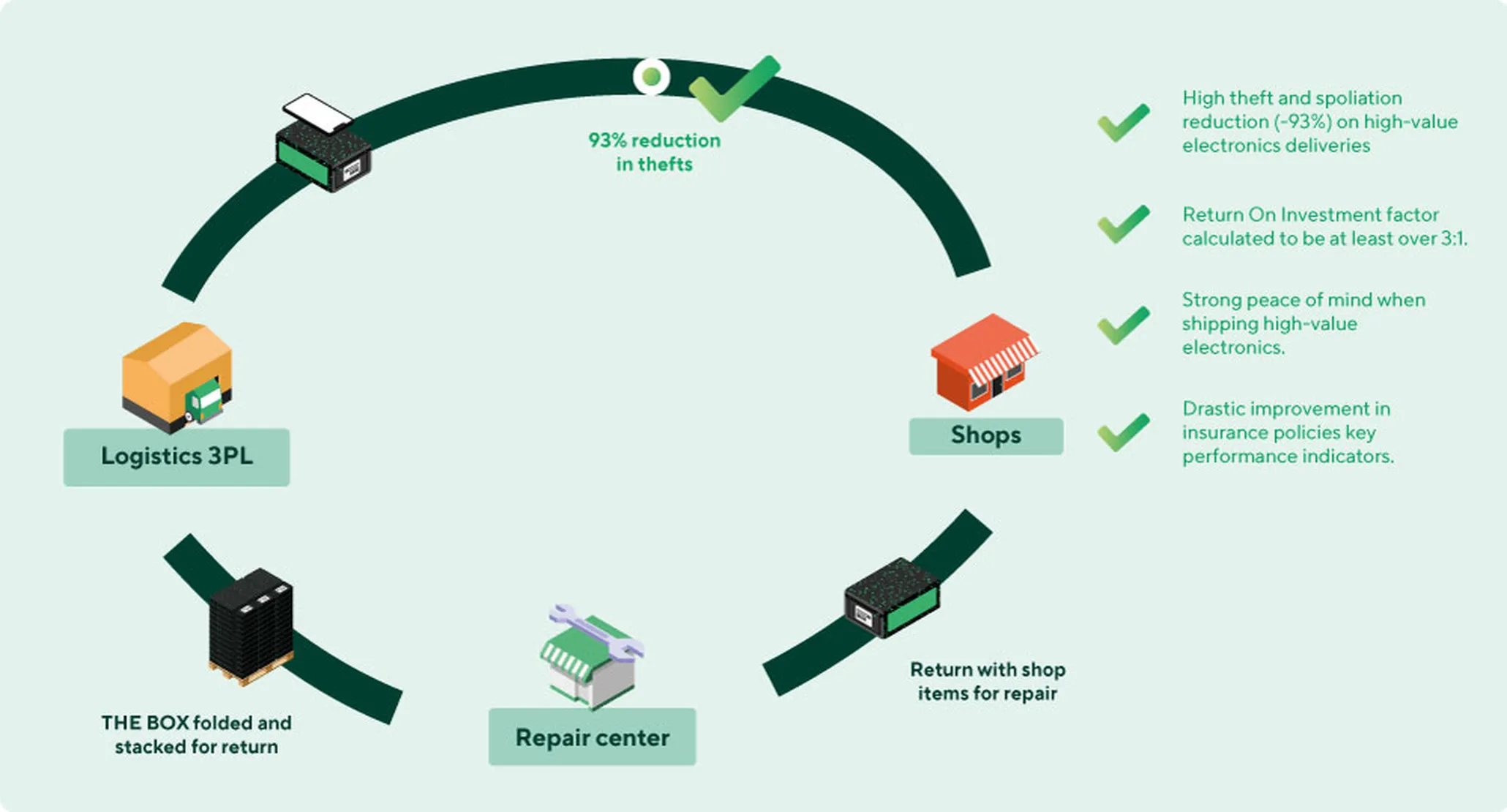
The deployment is in its scaling phase, and the path forward is operational rather than experimental.
Fleet expansion. The retailer is on track to grow the fleet from 1,300 units as of December 2025 to 1,600 units by end of 2026, a 23% increase that maps directly to expanded store and flow coverage.
Network coverage expansion. With 130+ stores currently in scope and approximately 25% of the network covered, the natural next phase is deeper geographic coverage, additional flow types (repairs, accessories, inter-store transfers), and tighter integration into the retailer's broader logistics stack. The model is no longer being proven. It is being extended.

93% reduction in theft and loss ratio — a real game-changer for our high-value flows. The insurance market in logistics is very tense. For a year, the insurer didn't even want to insure us. With LivingPackets, we proved we are taking steps to improve our KPIs.
The same questions this customer faced apply to your own high-value shipments. Start a conversation with our team, or run you own losses and ROI in our self-help calculator.


